Wrenfield Hospital
Energy Performance
Contract
14 October 2026
Contents
This response is ordered to the evaluation criteria published in section 6 of the Instructions to Tenderers. Each section states the criterion it answers and the marks available. Volume 2 carries the returnable schedules. Volume 3 carries the priced bill and the draft contract mark-up.
| 00 | Covering letter | Compliance statement and named contact | not scored | 3 |
| Executive summary | The offer in six numbers | not scored | 4 | |
| 01 | Understanding the site | Baseline, metering survey, where the energy goes | context | 5 |
| What the Board asked for · Wrenfield today · Where the energy goes · Three findings | 6–9 | |||
| 02 | The technical solution | Five measures, the scheme, the savings model | C1 · 30 marks | 10 |
| The scheme on one page · How an EPC works · Measures 01 to 05 · The savings model | 11–19 | |||
| 03 | The commercial offer | The guarantee, risk allocation, measurement, cash | C2 · 20 marks | 20 |
| What we carry · How savings are measured · Twelve-year cash position | 21–23 | |||
| 04 | Delivery in a live hospital | Programme, clinical constraints, mobilisation | C3 · 20 marks | 24 |
| Programme · Working around clinical services · The first ninety days | 25–27 | |||
| 05 | Operation, carbon and team | Twelve-year service, carbon trajectory, people | C4/C5/C6 · 30 | 28 |
| Service model · Carbon to 2040 · The team · Comparable contracts · Compliance | 29–33 | |||
volume 2
Returnable schedules R1 to R14, completed on the Board's own forms.
volume 3
Priced bill, cashflow model and the draft contract mark-up.
appendices
Metering survey, chiller condition report, four CVs, three certificates.
Head of Procurement, Estates and Facilities
Northgate Health Board
Cavendish House, Northgate
Unit 4, Calder Works, Ashcombe
hello@halden.example
14 October 2026
Halden Energy Services Limited submits this response in full compliance with the Instructions to Tenderers and with Addendum 1 issued on 22 September 2026. No qualifications are attached to the offer. Two clarifications are recorded at the end of this letter.
The offer is an energy performance contract covering five measures at Wrenfield, with a twelve-year guarantee period from January 2029 to December 2040. Halden funds the works in full: £9.38m, with no capital contribution from the Board and no charge on the Board's balance sheet. Halden guarantees an annual saving of £1,287,000 against the 2025 weather-corrected baseline, and pays the difference in cash where the saving is not achieved.
The Board's cash position is positive from the first year of operation. Guaranteed savings exceed the annual contract payment by £202,000 in the first guarantee year and by £3.18m across the contract. At handback in 2040 the plant transfers to the Board at nil cost, with a remaining service life of fifteen years or more on the principal assets.
Three points are stated plainly here rather than left to be found later.
- The volume saving is larger than the cost saving. Energy consumption falls by 31.2 per cent and energy cost by 26.5 per cent, because the largest volume saving is on gas, which is the cheaper fuel. Both figures appear wherever the saving is quoted in this response.
- Two measures require a four-day steam shutdown. The programme places it in the August 2028 low-occupancy window discussed with the Estates team at the site visit on 18 September. An alternative sequence, costed at £164,000 more, is set out in section 04 if that window is withdrawn.
- The published baseline in the tender pack reads 46.1 GWh. Our metering survey found 44.5 GWh once the decommissioned laundry supply is removed. The lower figure is used throughout, which reduces the guarantee we are able to offer and is the more conservative basis.
Rachel Odell, Contract Director, is the named contact and holds authority to confirm anything committed here. Rachel attended the site visit on 18 September and the clarification meeting on 30 September.
This offer is open for acceptance for 120 days from the return date.
The offer in six numbers
Five measures on the central plant and distribution systems, funded and guaranteed by Halden, operated for twelve years and handed back working.
what the contract does
Wrenfield uses 44.5 GWh of energy a year across 62,400 m² and 540 beds. Two thirds of it is gas, most of that raised as steam in boilers installed in 1998 and distributed to a load that no longer needs steam. The chillers are at the end of their service life and run at a measured seasonal efficiency of 2.9.
The five measures replace the chiller plant, recover heat that is currently rejected, decommission the steam ring, take control of the ventilation, and meter the site at circuit level. Consumption falls by 13.9 GWh a year.
Halden carries the performance risk for the full term. Where the measured saving falls short of the guarantee, Halden pays the difference in cash within 30 days of the annual reconciliation. Where it exceeds the guarantee, the excess is shared 70 to the Board and 30 to Halden.
the offer at a glance
| Contract form | Guaranteed savings |
| Guarantee period | 2029 to 2040 |
| Capital works | £9,380,000 |
| Annual payment | £1,085,000 |
| Guaranteed saving | £1,287,000 |
| Net to the Board, each year | £202,000 |
the shortfall test
If the site saves £1.1m in a given year, Halden pays the Board £187,000. The Board's position is unchanged by the shortfall.
the Board spends nothing
No capital, no balance sheet charge and no procurement of plant. The first payment falls due on 1 January 2029, after the works are complete.
the saving is not a forecast
It is a contractual figure, tested each year by a verifier the Board appoints jointly, and paid in cash when it is missed.
the plant is the Board's in 2040
Transferred at nil cost, against a handback condition schedule agreed at signature and backed by £400,000 of retention.
Understanding
the site
Halden metered the site for eleven days in September and compared the result against three years of billing. This section states what was measured, where the energy goes, and the three findings the scheme is built on.
What the Board asked for
Six requirements are set out in section 4 of the Instructions to Tenderers. Each is answered in full, and the page carrying the answer is named against it.
| req | the Board's requirement | Halden's answer | page |
|---|---|---|---|
| R1 | Energy cost reduced by no less than 20 per cent against the 2025 baseline, guaranteed for the term. | 26.5 per cent guaranteed. Consumption falls 31.2 per cent. Shortfall paid in cash. | 19 |
| R2 | No capital expenditure by the Board. | £9.38m funded by Halden through the contract. No Board capital, no balance sheet charge. | 23 |
| R3 | Full clinical resilience maintained. No unplanned interruption to theatres, critical care or the emergency department. | Temporary plant on hire for every changeover. Nine switchover windows, all agreed with the clinical leads before mobilisation. | 26 |
| R4 | Contribution to the Board's 50 per cent emissions reduction by 2032. | 2,642 tCO₂e a year from 2029, which is 30.8 per cent of site emissions and 61 per cent of the Board's 2032 gap. | 30 |
| R5 | Assets transferred in serviceable condition at the end of the term. | Handback condition schedule agreed at contract signature. Fifteen years of remaining life on principal assets, with a retention held against it. | 29 |
| R6 | Open-book measurement and verification, auditable by the Board's advisers. | IPMVP Option C, whole-site, with the Board holding read access to the metering platform from day one. | 22 |
recorded at the site visit, 18 september
- The steam ring serves five loads. Three of them were converted to low temperature hot water in 2014 and the calorifiers were left in place.
- Chiller 2 has been off line since March and the site has run on N without redundancy through two summers.
- The Estates team holds trend data going back to 2019, which the tender pack did not mention. It has been used to weather-correct the baseline.
- Ward 7 and the day surgery unit are scheduled for refurbishment in 2030. Both are excluded from the lighting measure to avoid abortive work.
the one thing the pack does not settle
The Board's electricity supply contract expires in March 2029. The tender pack does not state the intended basis after that date.
This response assumes the published framework rate, indexed. The guarantee is expressed in energy units as well as in money, so a tariff change moves the cash value of the saving without moving the performance obligation. The mechanism is on page 22.
Wrenfield today
Seven buildings, 62,400 m², 540 beds, in continuous use. Energy intensity is shown per building, measured over eleven days in September and normalised to a full year.
Where the energy goes
Every unit bought in 2025, traced from the meter to the point of use. Widths are proportional. The grey band is what never reaches a department.
16 per cent is lost
7.1 GWh a year goes in boiler conversion and in a 1.9 km steam and hot water ring. That is £447,000 at 2025 rates.
steam serves three loads
Sterilising takes 1.6 GWh. The remaining 13.6 GWh raised as steam is used for heating and hot water, both of which run below 80°C.
cooling runs all year
Chillers drew load in every month of 2025, including January. Free cooling is available for 2,900 hours a year and is not installed.
Three findings
Each of the five measures answers one of these. Nothing is proposed that does not.
The boilers are sized for a hospital that is no longer here
Installed boiler capacity is 12 MW. Measured peak demand is 6.8 MW, and for 6,100 hours of the year demand sits below 2.5 MW. The boilers modulate to 30 per cent and then cycle, which is where the 2.5 GWh of conversion loss is created.
Answered by measures 02 and 04. Two boilers are retained and resized for the real load. The third is removed and its space used for the heat recovery plant.
The site does not turn down, on any day of the week
Overnight demand is 82 per cent of the afternoon peak, and Sunday tracks Tuesday within four per cent. Every air handling unit on site is constant volume with no setback, including the 22 serving outpatients and education, which are empty for 128 hours a week.
Answered by measure 03. Demand controlled ventilation on 22 units, with clinical areas excluded and left at their design air change rates.
Heating and cooling are called at the same time, in every month
Air is cooled to 12°C at the central plant and reheated locally to suit each zone. Sub-metering recorded 2,340 hours in 2025 when heating and cooling ran simultaneously on the same unit. The energy spent on that is paid for twice.
Answered by measures 01, 03 and 04. Supply temperature reset, and heat rejected by the chillers recovered into the hot water circuit rather than sent to the roof.
The technical
solution
Five measures. Each one answers a finding from section 01, carries its own saving, and can be built without the others. Nothing here depends on a behaviour change by clinical staff.
The scheme on one page
What is replaced, what is retained, what is removed. Ringed items are new plant funded by Halden.
nothing depends on behaviour
Every saving is delivered by plant or by controls. No measure requires ward staff to do anything differently.
clinical spaces are untouched
Theatres, critical care and the isolation rooms keep their design air change rates. They are excluded from the ventilation measure.
each measure stands alone
Measures can be deferred or dropped at contract award. Section 03 states the effect of each on the guarantee.
How the contract works
An energy performance contract pays for plant out of the energy the plant stops using. The Board's total outgoing falls from day one and keeps falling when the contract ends.
if the saving is missed
Savings are measured against the agreed baseline every year by an independent verifier appointed jointly. Where the measured saving is below the guarantee, Halden pays the difference in cash within 30 days. The Board's position does not move.
| Guaranteed saving | £1,287,000 |
| Measured saving, year 4 | £1,100,000 |
| Paid by Halden to the Board | £187,000 |
The guarantee is unlimited over the term and is not capped at the value of the annual payment. It is backed by a parent company guarantee, attached at appendix E.
if the saving is beaten
Measured savings above the guarantee are shared: 70 per cent to the Board, 30 per cent to Halden. The share is calculated on the same annual reconciliation and settled at the same time.
| Guaranteed saving | £1,287,000 |
| Measured saving, year 4 | £1,390,000 |
| Excess | £103,000 |
| Retained by the Board | £72,100 |
Halden's share is the only part of the fee that is not fixed. It exists so that tuning the plant after year one is worth doing.
the Board
Provides access, keeps paying its own energy bills, appoints the verifier jointly with Halden. No capital, no performance risk.
Halden
Funds, designs, builds, operates and maintains the plant to 2040. Carries the savings risk and the asset risk.
the verifier
Independent, appointed jointly, paid equally by both. Recalculates the baseline each year and signs the reconciliation.
Chiller plant replacement and free cooling
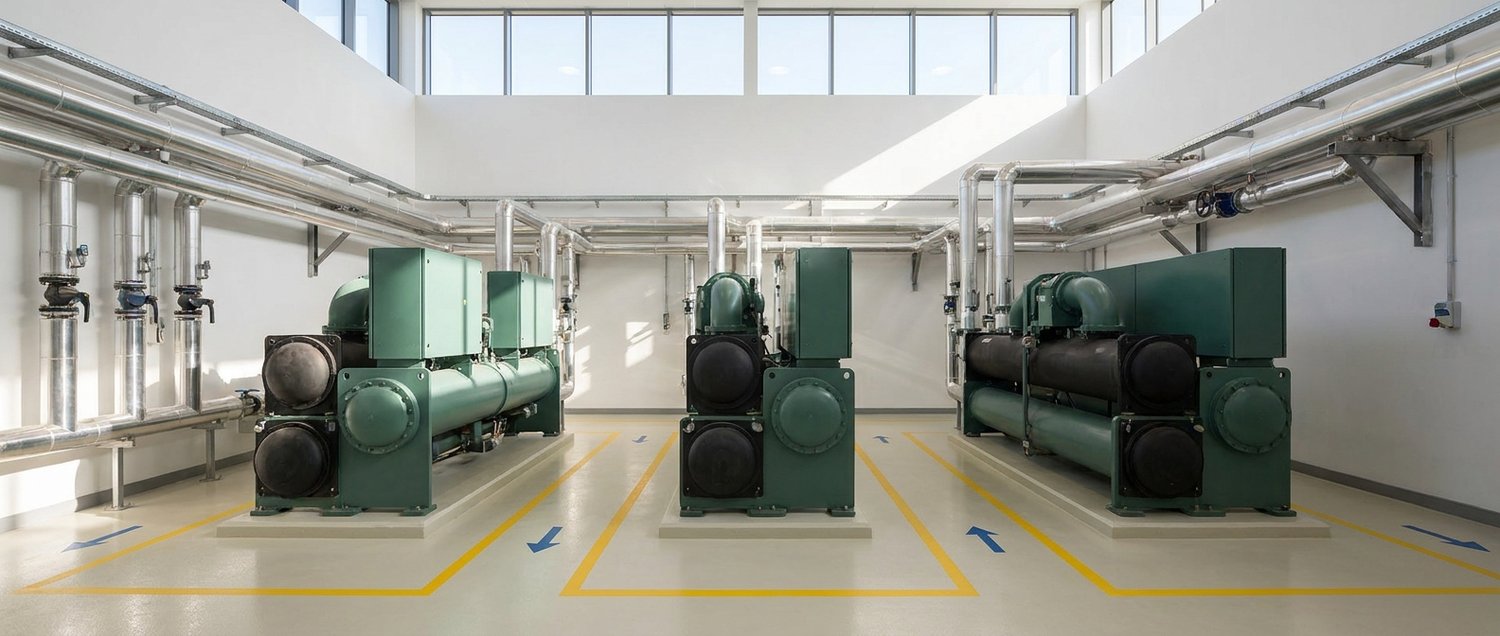
Three chillers at the end of life, replaced with high efficiency units and a dry cooler array that carries the load whenever the outside air can do the work.
what is installed
- Three 1.4 MW water-cooled centrifugal chillers with variable speed drives, replacing units installed in 1998 and 2003.
- A 900 kW dry cooler array on the block G roof, providing free cooling below 9°C ambient.
- Primary variable flow pumping, replacing the constant primary and secondary arrangement.
- Chilled water supply temperature reset on measured load, replacing the fixed 6°C setpoint.
- Chiller 2, off line since March 2026, is removed. The scheme restores N+1 across the full site load.
what it answers
Findings 01 and 03. The existing plant runs at a measured seasonal efficiency of 2.9 against a current market range of 5.4 to 6.1, and it runs in January because there is no alternative source of cooling on site.
Chiller condition survey and vibration analysis at appendix B. Both remaining units are beyond economic overhaul: the report puts the cost of returning chiller 2 to service at £312,000 with no efficiency gain.
| Electricity saved | 2,150 MWh |
| Annual saving | £412,800 |
| Capital cost | £3,200,000 |
| Carbon avoided | 445 tCO₂e |
| Simple payback | 7.8 years |
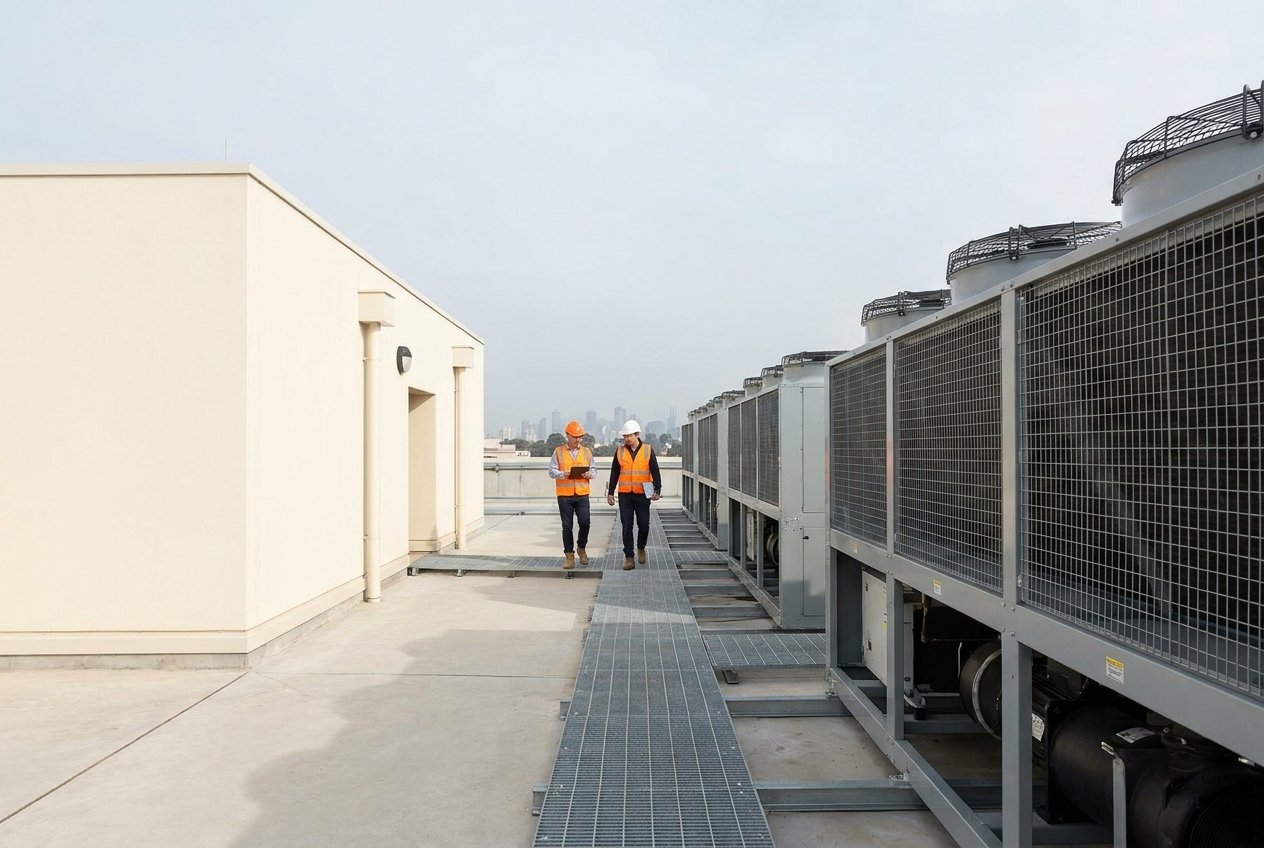
clinical interface
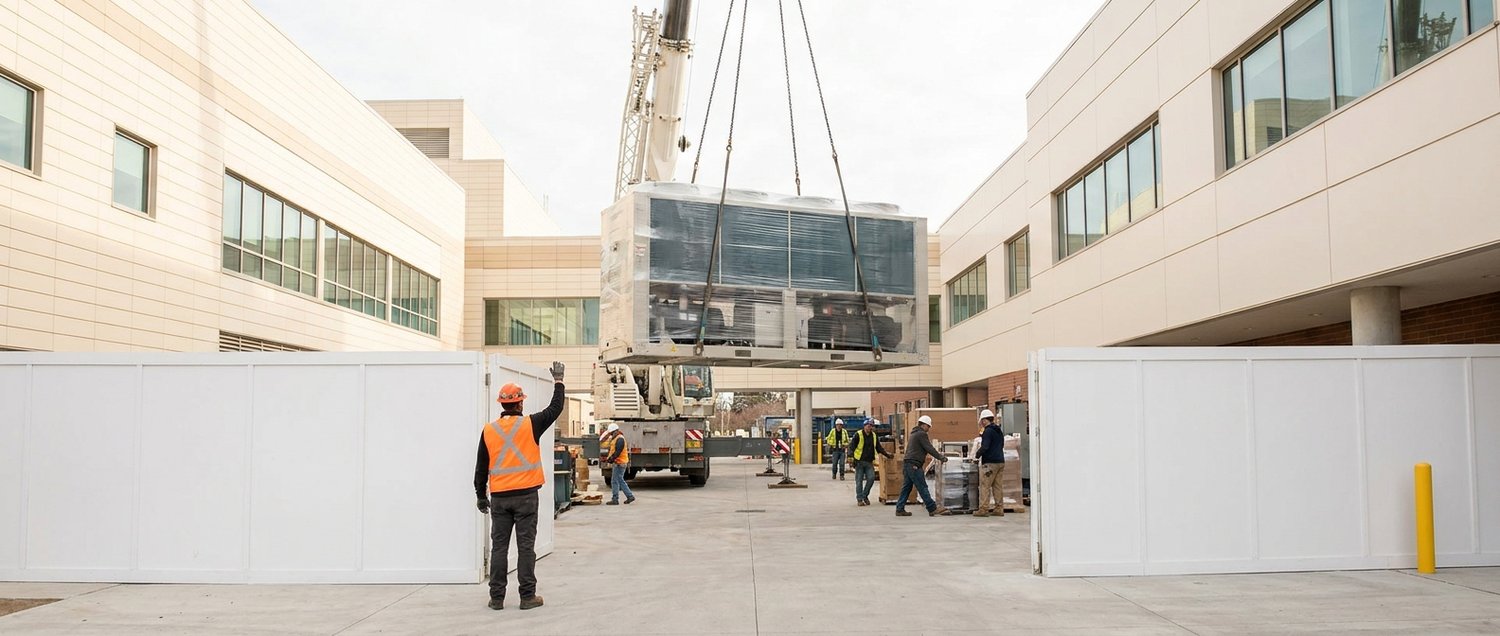
Theatres and critical care stay on cooling throughout. Two 750 kW chillers are hired for the changeover, sited on the service yard.
programme
Package 2. Weeks 14 to 38, outside the summer peak. One unit at a time, N+1 held at every stage.
the risk we carry
Measured efficiency below design. Ten days of witnessed performance testing at handover, with retention held until it is met.
Heat recovery, and the steam ring removed
The largest single measure. Heat currently rejected to the roof is recovered into the hot water circuit, and the site stops raising steam for loads that do not need it.
what is installed
- A 1.4 MW plate heat exchanger and buffer vessel taking heat from the chiller condenser circuit and the boiler flue.
- Decommissioning of the 1.9 km steam ring, three calorifiers and the condensate return, all installed in 1998.
- Conversion of the two retained loads, sterile services and the kitchen, to a local steam generator sized at 340 kW.
- Reinsulation of the retained hot water ring to current standards, removing 3.4 GWh of distribution loss.
The steam ring is the single largest source of loss on the site and the only measure requiring a shutdown. Four days, in the August 2028 window. The alternative sequence is on page 25.
| Gas saved | 5,900 MWh |
| Annual saving | £300,900 |
| Capital cost | £2,350,000 |
| Carbon avoided | 1,080 tCO₂e |
| Simple payback | 7.8 years |
what it answers
Findings 01 and 03. It also removes the largest maintenance liability on the site: the Board spent £84,000 on steam distribution repairs in 2025, which is not counted in the guarantee.
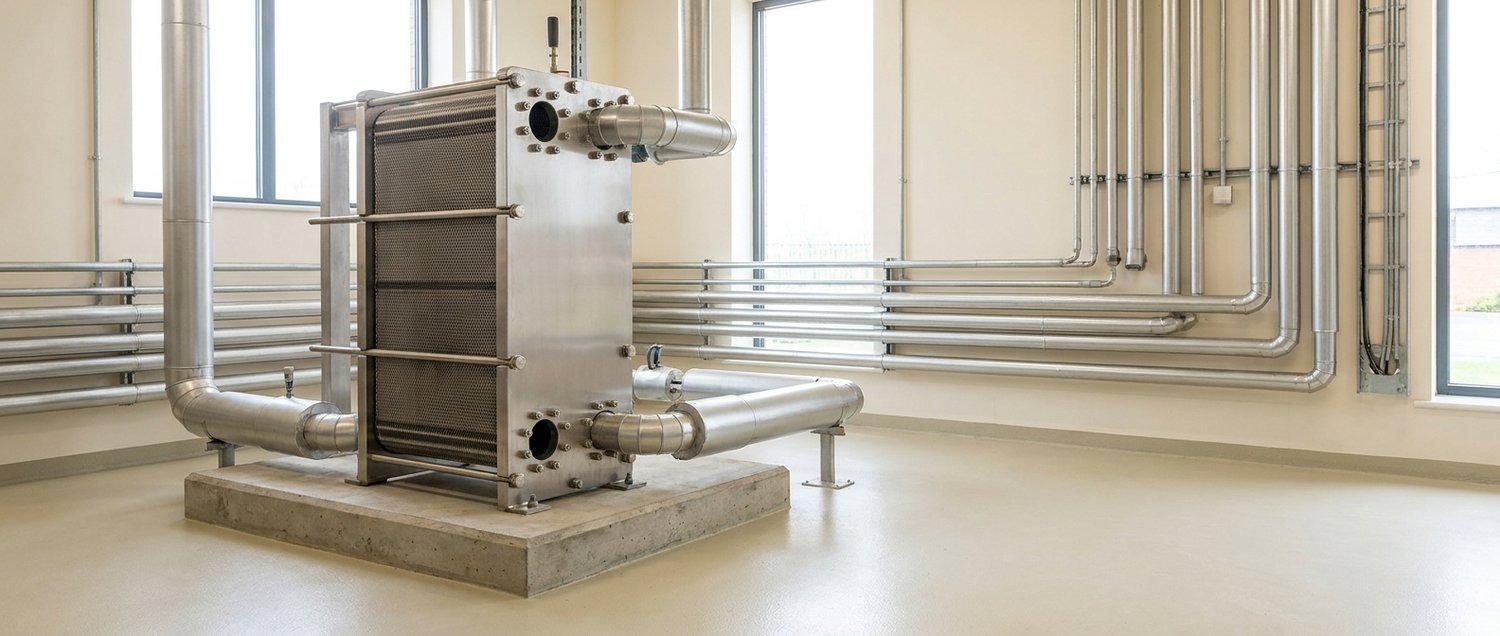
clinical interface
Sterile services moves to the local generator before the ring is drained. Commissioned and witnessed by the Board's authorised person.
programme
Package 3. Weeks 48 to 91, with the four-day shutdown in week 87.
the risk we carry
Asbestos in the ring insulation. Surveyed in September, type 3 report at appendix C. Removal is priced in the capital cost.
Ventilation: fans, setback and demand control
Twenty-two air handling units serving non-clinical areas, currently running at full volume every hour of the year. Clinical ventilation is untouched.
what is installed
- EC plug fan replacement on 22 units, with inverter control on supply and extract.
- CO₂ and occupancy sensing in outpatients, diagnostics, education and admin, driving volume down when the space is empty.
- Time schedules matched to actual departmental hours, taken from the room booking system rather than assumed.
- Supply temperature reset, which removes the reheat identified in finding 03.
- Filter differential pressure monitoring, so filters are changed on condition.
what is excluded, and why
Theatres, critical care, isolation rooms, the sterile services unit, pharmacy aseptic and the mortuary keep their design air change rates and their existing controls. Twelve units in total. The Board's authorised engineer for ventilation has confirmed the exclusion list in writing, attached at appendix D.
| Electricity saved | 1,180 MWh |
| Gas saved | 2,400 MWh |
| Annual saving | £348,960 |
| Capital cost | £1,750,000 |
| Simple payback | 5.0 years |
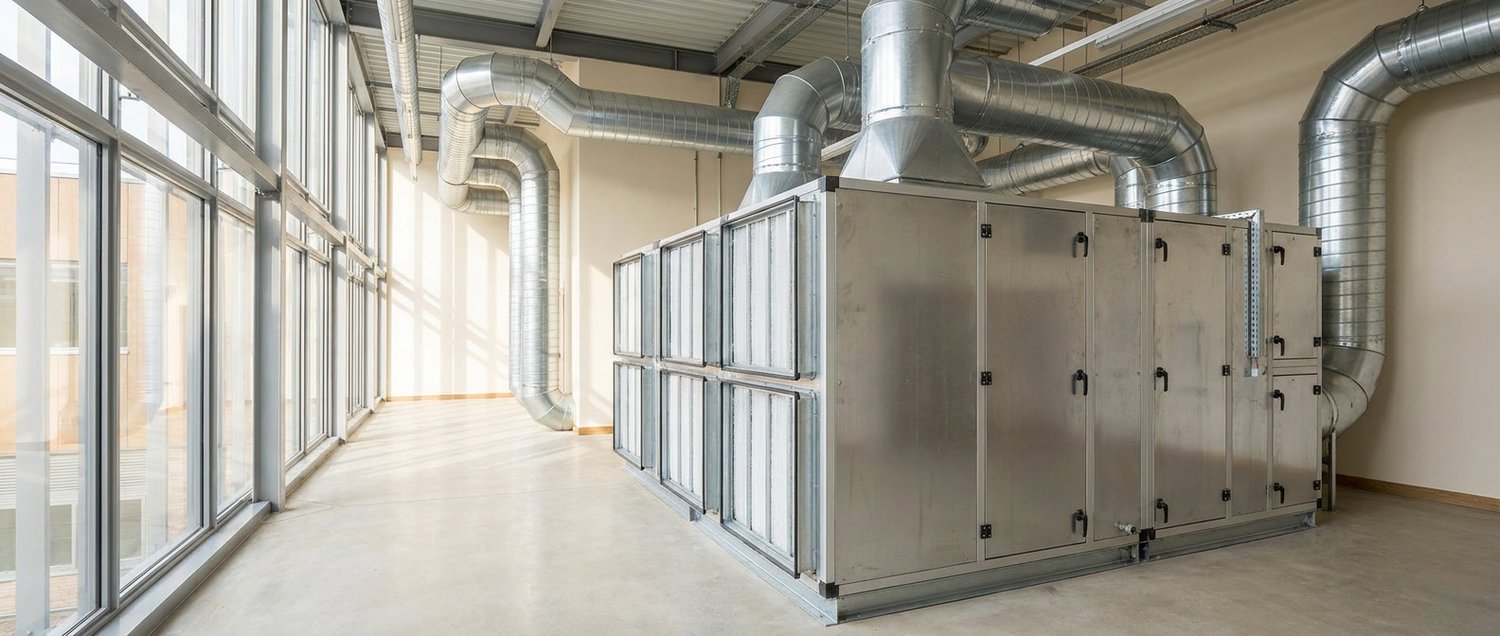
clinical interface
None. Every unit in scope serves non-clinical space. Each is isolated and tested individually, out of hours.
programme
Package 4. Weeks 30 to 72, two units a week, running alongside packages 2 and 3.
the risk we carry
Complaints about temperature or air movement after commissioning. A four-week tuning period is priced into each unit's handover.
Controls, metering and the analytics layer
The measure that makes the other four measurable. Every saving in this response is attributable to a meter, and the Board holds read access from the first day of installation.
what is installed
- Replacement of the 1998 building management system head end, retaining the field devices that survive the condition survey.
- 214 sub-meters at 15-minute resolution, on electricity, gas, heat and chilled water.
- An analytics layer running fault detection across all plant, with alarms raised against a named engineer rather than a screen.
- Board read access from day one, covering the raw meter files as well as the reports.
| Electricity saved | 480 MWh |
| Gas saved | 1,500 MWh |
| Annual saving | £168,660 |
| Capital cost | £1,100,000 |
| Simple payback | 6.5 years |
The saving claimed here is only what fault detection recovers: plant left in hand, schedules overridden and never reset, valves passing. It excludes any saving attributed to the other four measures.
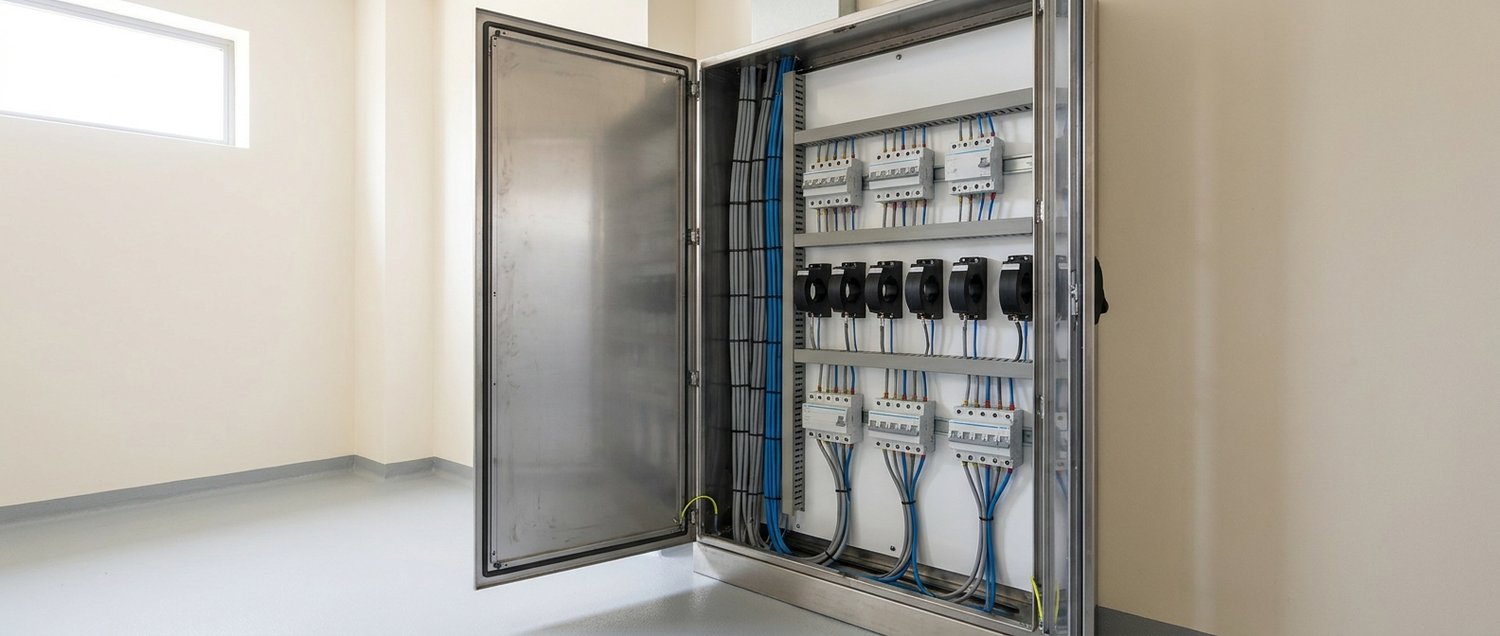
clinical interface
Critical alarms are migrated one panel at a time with the existing system live in parallel. No period without alarm coverage.
programme
Package 1. Weeks 1 to 26, first in sequence so that the baseline is metered before anything else changes.
the risk we carry
Field devices failing the condition survey. A provisional sum of £140,000 sits within the £1,100,000 capital cost above.
Lighting replacement
The smallest saving in the scheme, and the only measure that does not pay back inside the term. It is included for two reasons, both stated below.
what is installed
- 5,950 LED fittings across blocks A, B, C, E and F, replacing fluorescent fittings installed between 1998 and 2009.
- Absence detection in circulation, stores, plant rooms and offices. Wards keep manual control at the bed.
- Daylight dimming on the 640 perimeter fittings in blocks D and E.
| Electricity saved | 290 MWh |
| Annual saving | £55,680 |
| Capital cost | £980,000 |
| Carbon avoided | 60 tCO₂e |
| Simple payback | 17.6 years |
this measure does not pay for itself
At 17.6 years the payback sits well outside the twelve-year term. Halden carries the difference. It is in the scheme for two reasons.
Requirement R5. The Board asked for assets in serviceable condition at handback. 62 per cent of the existing fittings are beyond manufacturer spares support, and the Estates team is holding stock recovered from decommissioned areas.
It carries no risk. Lighting savings are the most predictable in the scheme, which stabilises the guarantee against variation in the other four.
clinical interface
Ward-by-ward, in occupied bays, one bay at a time. Temporary lighting to the same lux level during each change.
programme
Package 5. Weeks 44 to 94, the longest and least disruptive package.
the risk we carry
Access to occupied wards. Rates assume 40 per cent of the work is out of hours, which is priced in.
The five measures, side by side
Each measure can be dropped at contract award. The right-hand column states what the guarantee becomes if it is.
| measure | elec MWh | gas MWh | saving a year | capital | payback | tCO₂e | if dropped | |
|---|---|---|---|---|---|---|---|---|
| 01 | Chiller plant and free cooling | 2,150 | — | £412,800 | £3,200,000 | 7.8 yr | 445 | £874,200 |
| 02 | Heat recovery, steam ring removed | — | 5,900 | £300,900 | £2,350,000 | 7.8 yr | 1,080 | £986,100 |
| 03 | Ventilation, fans and demand control | 1,180 | 2,400 | £348,960 | £1,750,000 | 5.0 yr | 683 | £938,040 |
| 04 | Controls, metering and analytics | 480 | 1,500 | £168,660 | £1,100,000 | 6.5 yr | 374 | not available |
| 05 | Lighting replacement | 290 | — | £55,680 | £980,000 | 17.6 yr | 60 | £1,231,320 |
| Total | 4,100 | 9,800 | £1,287,000 | £9,380,000 | 7.3 yr | 2,642 |
share of the saving
share of the capital
what "if dropped" means
The figure in the last column is the guarantee Halden would offer with that measure removed and the others unchanged. It is lower than the arithmetic difference in three cases, because measures 01, 02 and 03 share the same distribution system and each one makes the next slightly less productive. Measure 04 cannot be dropped: without metering there is nothing to verify against, and the guarantee falls away with it.
The savings model
How £1,287,000 is built, measure by measure. This is the number Halden guarantees and the number the annual reconciliation is tested against.
why the three percentages differ
The largest volume saving is on gas, at 9,800 MWh, and gas costs 5.1 pence a unit against 19.2 pence for electricity. So a saving that is large in energy is smaller in money. Carbon sits between the two, because gas is the more carbon-intensive fuel per unit but electricity is falling as the grid decarbonises.
The guarantee is written in money and in energy units. If tariffs move, the energy obligation is unchanged and the cash value is recalculated on the actual tariff. The Board is not exposed to a tariff fall eroding the guarantee, and Halden does not benefit from a tariff rise.
the baseline, defined
| Period | Jan to Dec 2025 |
| Electricity | 18,400 MWh |
| Gas | 26,100 MWh |
| Degree days | 2,214 |
| Occupied beds, mean | 488 |
| Adjusted annually for | weather, beds, floor area |
the guarantee, as it appears in the contract
“Halden guarantees that the Measured Saving in each Guarantee Year shall be no less than £1,287,000, and no less than 13,900 MWh of delivered energy, each adjusted in accordance with Schedule 7. Where the Measured Saving is less than the Guaranteed Saving, Halden shall pay the difference to the Board within 30 days of the Verifier’s Statement. This obligation is not subject to any cap.”
Clause 11.1, returned unamended.
The commercial
offer
What Halden carries, what the Board carries, and what is taken out of the calculation altogether. The guarantee is only as good as the measurement behind it, so the measurement is set out in full.

Who carries what
Every risk in the contract sits in one of four places. The fourth column is the one that is usually argued about at year three, so it is settled here.
| risk | Halden | shared | the Board | adjusted out | how it is handled |
|---|---|---|---|---|---|
| Construction cost above the tendered sum | ● | Fixed price. No contingency held against the Board. | |||
| Plant performing below design efficiency | ● | Witnessed performance testing, retention held until met. | |||
| Asset failure during the term | ● | Full replacement obligation, priced into the service charge. | |||
| Savings below the guarantee | ● | Shortfall paid in cash within 30 days. Uncapped. | |||
| Asbestos beyond the type 3 survey | ● | £180,000 provisional sum. Above that, shared equally. | |||
| The August 2028 shutdown window withdrawn | ● | Alternative sequence priced at £164,000. Split 50 / 50. | |||
| Access to occupied clinical areas | ● | Access plan agreed monthly. Delay beyond 15 days is at the Board's cost. | |||
| Change in law affecting the works | ● | First £250,000 by Halden, above that shared. | |||
| Energy tariff movement | ● | Guarantee restated in energy units. Cash follows the actual tariff. | |||
| Board-instructed change to scope | ● | Change control, with the guarantee restated at the same time. | |||
| Halden insolvency | ● | Parent company guarantee of £12m, step-in rights, 10 per cent bond. | |||
| Weather, colder or warmer than 2025 | ● | Degree-day correction on the baseline, every year. | |||
| Occupancy and bed numbers | ● | Baseline adjusted on occupied bed days. | |||
| New floor area or a new service | ● | Baseline adjusted on area and on connected load. | |||
| Grid carbon factor change | ● | Reported on the published factor for the year. No cash effect. |
what backs the guarantee
A parent company guarantee of £12m from Halden Group Holdings, a 10 per cent performance bond during construction, and 5 per cent retention held for twelve months past each package handover.
the shortfall is uncapped
Halden's liability for missed savings is not limited to the annual payment. Three bidders in this market cap it at the payment. This offer does not.
termination
The Board may terminate for convenience at any point from year five, paying the outstanding capital only. No termination premium, no loss of profit.
How savings are measured
A saving cannot be metered directly. What is metered is what the site used. The saving is the difference between that and what the site would have used, and the whole method is the calculation of the second number.
what adjusts the baseline, and what does not
| variable | basis | adjusts |
|---|---|---|
| Heating degree days | Published station data, 15.5°C base | yes |
| Cooling degree days | Same station, 18°C base | yes |
| Occupied bed days | Board's own returns | yes |
| Heated floor area | Board's asset register | yes |
| New connected load above 50 kW | Metered at the point of connection | yes |
| Energy tariff | Actual, from the Board's invoices | cash only |
| Staff behaviour | no | |
| Equipment left running | no |
The last two are Halden's risk. A hospital does not switch things off, and a guarantee that depends on it being asked to is not a guarantee.
the annual reconciliation
- 31 January. Halden issues the meter record for the year, unedited, with the raw files.
- 14 February. The verifier applies the adjustments and issues the adjusted baseline.
- 28 February. Both parties comment. Disagreements go to the contract's expert procedure.
- 15 March. The verifier signs the statement of savings. It is binding on both.
- 14 April. Any shortfall is paid, or any excess shared. Within 30 days, either way.
Cash position, 2027 to 2040
Savings above the line, payments to Halden below it. The Board is ahead in every year of the contract, including the two construction years, when savings accrue and nothing is paid.
what the annual payment is made of
| component | a year | over 12 years |
|---|---|---|
| Capital repayment and financing | £942,300 | £11,307,600 |
| Service, maintenance and lifecycle | £142,700 | £1,712,400 |
| Total payment to Halden | £1,085,000 | £13,020,000 |
Of the £11.31m, £9.38m is the works and £1.93m is the cost of the money. Both are fixed at signature. The service element indexes on CPI and nothing else.
how the works are funded
A public sector energy efficiency loan at 3.0 per cent fixed, drawn by Halden against this contract, with the Board named as beneficiary of the works.
The Board borrows nothing and guarantees nothing. If Halden defaults, the step-in provisions at clause 27 transfer both the plant and the loan on the same terms.
Delivery in a
live hospital
Twenty-two months of work on the plant that keeps theatres cool and wards warm, with no ward closed and no elective list cancelled. Nine switchover windows carry the whole risk, and all nine are named in this section.
Programme
Twenty-two months from contract signature to practical completion. Metering is first, so that the baseline is measured before anything is changed, and the guarantee period opens on 1 January 2029.
metering first, always
Package 1 finishes before the first plant is touched. A baseline agreed after the works have started is a baseline nobody can defend at year six.
cooling before the summer
Package 2 completes in September 2027, restoring N+1 before the 2028 cooling season. The site has run without redundancy for two summers.
the one hard date
The steam shutdown must fall in August 2028. If that window moves, the alternative sequence adds £164,000 and eleven weeks. Both are priced.
Working around clinical services
Nine moments in twenty-two months carry the clinical risk. Each one is named here, with the plant that carries the load while it is open.
| window | system | areas affected | duration | what carries the load | |
|---|---|---|---|---|---|
| 1 | May 2027 | BMS head end | Whole site, alarms only | 6 h | Existing system live in parallel, migrated panel by panel |
| 2 | Jun 2027 | Chilled water tie-in | Blocks A and D | 9 h, night | Two 750 kW hire chillers, service yard, running 48 h either side |
| 3 | Jul 2027 | Chiller 1 changeover | Block B, theatres | 14 h, night | Hire chillers plus chiller 3. N+1 held throughout |
| 4 | Sep 2027 | Chiller 3 changeover | Block B, critical care | 14 h, night | New chillers 1 and 2, both commissioned and witnessed first |
| 5 | Feb 2028 | LTHW ring section 1 | Blocks E and F | 2 days | Temporary boiler, 500 kW, on the north compound |
| 6 | Apr 2028 | LTHW ring section 2 | Block D, outpatients | 2 days | Same temporary boiler, relocated. Clinics unaffected |
| 7 | Aug 2028 | Steam ring drain-down | Sterile services, kitchen | 4 days | Local steam generator commissioned and witnessed six weeks earlier |
| 8 | Sep 2028 | Heat recovery tie-in | Domestic hot water, whole site | 10 h, night | Boilers 1 and 2, on the retained circuit |
| 9 | Oct 2028 | Final commissioning | None | — | All plant live. Witnessed performance testing over ten days |
four standing rules, for every hour on site
- No window opens without the load already carried. Temporary plant is on site, commissioned and load-tested before the permit is signed.
- The Board's authorised persons hold the permits. Halden's engineers work to them. Ventilation, pressure systems and electrical each have a named AP on the Board's side.
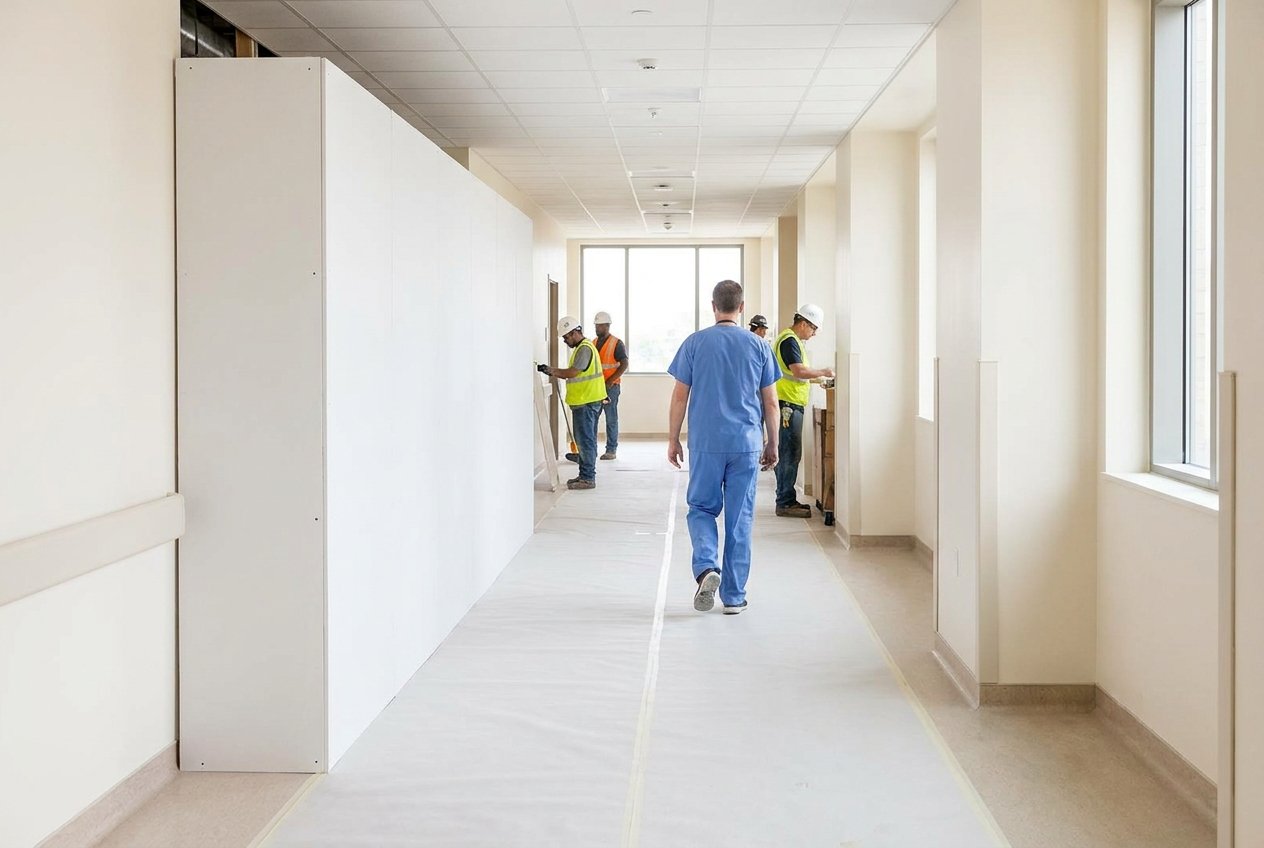
- Sealed routes, negative pressure, HEPA where the survey says so. Infection control approves every hoarding line before it is built.
- Noise and vibration are agreed ward by ward. Core drilling and cutting are booked with the ward manager against that ward's own quiet hours.
if a window is refused on the day
Every window has a named fallback date inside four weeks, held in the programme as float. Windows 2, 3 and 4 can each slip four weeks with no effect on completion.
Window 7 is the exception. It is the only one that cannot move inside the programme, and it is why the alternative sequence is priced rather than assumed away.
who decides
A weekly site meeting with the Estates duty manager, and a monthly session with the clinical leads for theatres, critical care and the emergency department. Windows are confirmed at the monthly session, six weeks ahead, and are not moved after that except by the Board.
The first ninety days
What happens between signature and the first meter going in, and what the Board is asked to do in the same period.
what Halden delivers by day 90
- Parent company guarantee, performance bond and all insurances lodged with the Board, by week 3.
- Detailed design for packages 1 and 2, issued for the Board's comment at week 8.
- Refurbishment and demolition asbestos survey across the steam ring route, week 6.
- The permit protocol, signed by both parties' authorised persons, week 9.
- Sixty sub-meters live, with the Board holding read access to the raw data.
- The baseline data protocol, agreed with the verifier and signed by both parties.
what Halden needs from the Board
| item | by | owner |
|---|---|---|
| Named authorised persons, three disciplines | week 2 | Estates |
| Appointment of the verifier, jointly | week 4 | Board |
| Access to plant rooms, standing permit | week 4 | Estates |
| Three years of occupied bed day returns | week 5 | Informatics |
| Asset register and floor areas, current | week 5 | Estates |
| Infection control sign-off on hoarding lines | week 10 | IPC team |
| Clinical leads confirmed for the monthly session | week 6 | Board |
Six items, none of them onerous, all of them on the critical path. They are listed here so they are in the Board's own programme rather than raised at week 8.
Operation, carbon
and team
Twelve years of operation is the part of this contract that is easiest to write and hardest to hold. What is promised here is staffed, priced and scheduled, and the handback condition is agreed before the first bolt is turned.

The twelve-year service
Halden maintains and replaces everything it installs, for twelve years, at a price fixed at contract signature and indexed only on CPI.

what the service charge covers
- Planned maintenance on all installed plant, quarterly, to the manufacturer's schedule or better.
- All reactive work on installed plant. Four-hour attendance for anything affecting a clinical area, next working day otherwise.
- Full lifecycle replacement, including the compressor overhaul in year 9 and the plate pack in year 11.
- Continuous tuning against the analytics layer, with a named engineer holding the site.
- An annual performance report to the Board, and attendance at the Board's estates committee twice a year.
Halden does not maintain plant it did not install. The Board's existing maintenance contract is unaffected outside the scope on page 11.
handback condition
Agreed at contract signature and fixed for the term. The schedule states, asset by asset, the condition and remaining life required on the day of transfer.
| Chillers | 15 yr remaining |
| Heat recovery plant | 18 yr remaining |
| Controls and meters | 8 yr remaining |
| Retention against the schedule | £400,000 |
one named person, for the term
One engineer holds Wrenfield for the term, on site two days a week for the first two years and one day a week after that. Named at award, and replaced only with the Board's agreement.
Carbon to 2040
The scheme takes 2,642 tCO₂e a year off the site from 2029. That is 61 per cent of the distance between Wrenfield today and the Board's 2032 target. What closes the remaining 39 per cent is named below.
what closes the remaining 1,050 tonnes
After these five measures the site still burns 16,300 MWh of gas, and that is where the residual carbon sits. Removing it means heat pumps on the retained hot water circuit, which needs an electrical supply upgrade at the site intake.
The heat recovery plant in measure 02 is sized and positioned so that conversion is a connection rather than a rebuild. An indicative scheme and budget cost are at appendix F. It is not part of this offer and is not counted in any figure in this response.
social value
- Four apprenticeships based at Wrenfield across the construction period.
- 62 per cent of the works subcontracted inside the Board's region.
- Steam ring copper and the three calorifiers recovered and recycled, with the value credited to the Board.
The team
Five named people, committed for the periods stated. None is shared with another bid in this procurement.
during mobilisation
Rachel Odell, weekly, with the Board's project lead. Every item on page 27 has a named owner on both sides.
during construction
Daniel Okonjo on site full time. Rachel Odell at the monthly session with the clinical leads.
from 2029
The site engineer day to day, one day a week on site. Rachel Odell at the estates committee twice a year.
Rachel Odell
Led three guaranteed savings contracts to completion, including Cranmere General, which is in its seventh operational year and has beaten its guarantee in six of them. Holds the authority to settle a shortfall without reference upward, which is why the named contact on the covering letter is the same person.
Ivo Marchetti
Designed the chiller and heat recovery scheme at Marlow Bay, on a plant room of comparable age and constraint. Wrote the Wrenfield metering survey and stands behind the 44.5 GWh baseline used throughout this response.
Daniel Okonjo
Ran the Ashcombe University works: forty switchovers on a live campus with no unplanned outage. Attended the Wrenfield site visit and produced the nine-window schedule on page 26.
Priya Nandakumar
Prepares the annual submission the verifier tests. Has taken two contracts through a disputed reconciliation, both settled at the expert stage without arbitration. Wrote the adjustment table on page 22.
Hana Brennan
Healthcare estates only for eleven years. Holds the relationship with infection control on every live-site package and signs each hoarding line before it is built.
what is committed, and what is not
The five people above are named in the contract with their committed percentages. Substituting any of them requires the Board's written agreement, and the replacement must be equivalent or better on the same criteria.
Below this line the team is drawn from a pool of 34 engineers. Halden does not name people it cannot hold to a contract for twelve years.
Three comparable contracts
Every operational year Halden has ever run, measured against the guarantee given at the start. Seventeen years, two of them short.
Cranmere General Hospital
| Beds | 410 |
| Term | 9 yr, 2018–2027 |
| Capital | £6,100,000 |
| Guarantee | £840,000 |
| Mean achieved | 103.6% |
Chillers, controls and a steam decommissioning of the same form as measure 02. The closest of the three to Wrenfield in age, plant and constraint.
Marlow Bay Health Campus
| Beds | 280 |
| Term | 12 yr, 2021–2033 |
| Capital | £8,400,000 |
| Guarantee | £1,020,000 |
| Mean achieved | 102.0% |
Year one came in at 99 per cent. Halden paid £10,200 in March 2023 and the plant was retuned over the following quarter. Years two to four have all been above.
Ashcombe University
| Buildings | 14 |
| Term | 8 yr, 2020–2028 |
| Capital | £4,700,000 |
| Guarantee | £610,000 |
| Mean achieved | 101.0% |
Forty switchovers on a live campus, none of them unplanned. Daniel Okonjo ran the site and holds the same role here.
the two shortfalls
Marlow Bay in 2022 and Ashcombe in 2023. Both were paid inside 30 days of the verifier's statement, at £10,200 and £6,100. Both referees are named at appendix E and both have been asked in advance to answer questions about the shortfall as well as the result.
Compliance and assumptions
Fourteen returnable schedules, all completed on the Board's own forms. One is returned with amendments, listed in full below.
returnable schedules
| ref | schedule | returned in |
|---|---|---|
| R1 | Form of tender | Vol 2 |
| R2 | Certificate of non-collusion | Vol 2 |
| R3 | Parent company guarantee | Vol 2, app. E |
| R4 | Insurance certificates | Vol 2 |
| R5 | Health and safety questionnaire | Vol 2 |
| R6 | Technical response | Vol 1, p10–19 |
| R7 | Commercial response | Vol 1, p20–23 |
| R8 | Construction programme | Vol 1, p25 |
| R9 | Resource schedule | Vol 2 |
| R10 | Priced bill of quantities | Vol 3 |
| R11 | Measurement and verification plan | Vol 1, p22 |
| R12 | Social value commitment | Vol 1, p30 |
| R13 | Contract mark-up | Vol 3, amended |
| R14 | Referee details, three contracts | Vol 2, app. E |
the three amendments to R13
Clause 14.2. Shortfall payment period changed from 60 days to 30.
Clause 22.4. Termination for convenience brought forward from year seven to year five.
Clause 31.1. Verifier's statement made binding on both parties, replacing the Board's sole determination.
assumptions
- Electricity at 19.2 pence and gas at 5.1 pence a unit, taken from the Board's 2025 invoices. From April 2029, the published framework rate, indexed.
- The August 2028 window is available for four consecutive days. The priced alternative is on page 25.
- The baseline is 44.5 GWh, weather-corrected on 2,214 degree days, and excludes the decommissioned laundry supply.
- Occupied bed days stay within eight per cent of the 2025 mean of 488. Outside that, the baseline is adjusted.
- No change to the clinical footprint before 2031 beyond the Ward 7 and day surgery refurbishment already programmed.
- Asbestos is limited to the type 3 survey findings. A provisional sum of £180,000 is held inside the capital cost.
- Statutory consents are obtained within twelve weeks of application.
exclusions
- Maintenance of plant Halden did not install.
- Lighting in Ward 7 and the day surgery unit, excluded to avoid abortive work before the 2030 refurbishment.
- Heat pump conversion of the retained gas load. Indicative scheme at appendix F, priced separately and excluded from every figure in this response.
- Electrical supply upgrade at the site intake.
- Building fabric repairs, other than making good at the dry cooler mounting.
- The Board's own energy supply contracts and their procurement.
Halden pays for the plant, guarantees the saving in cash, carries the shortfall without a cap, and hands Wrenfield back in 2040 with fifteen years of life left in it.
Unit 4, Calder Works, Ashcombe
hello@halden.example
Issued 14 October 2026
Open for acceptance for 120 days
Specimen document, built by Enzwa to show how a tender response of this kind is set. Northgate Health Board, Wrenfield Hospital and Halden Energy Services do not exist, and every figure in it is invented.