artificial intelligence · document workflows · Hong Kong
What AI could do with Hong Kong’s restaurant paperwork
A newer drawing can put an earlier check back into question. That is a useful place to start with AI workflow automation.
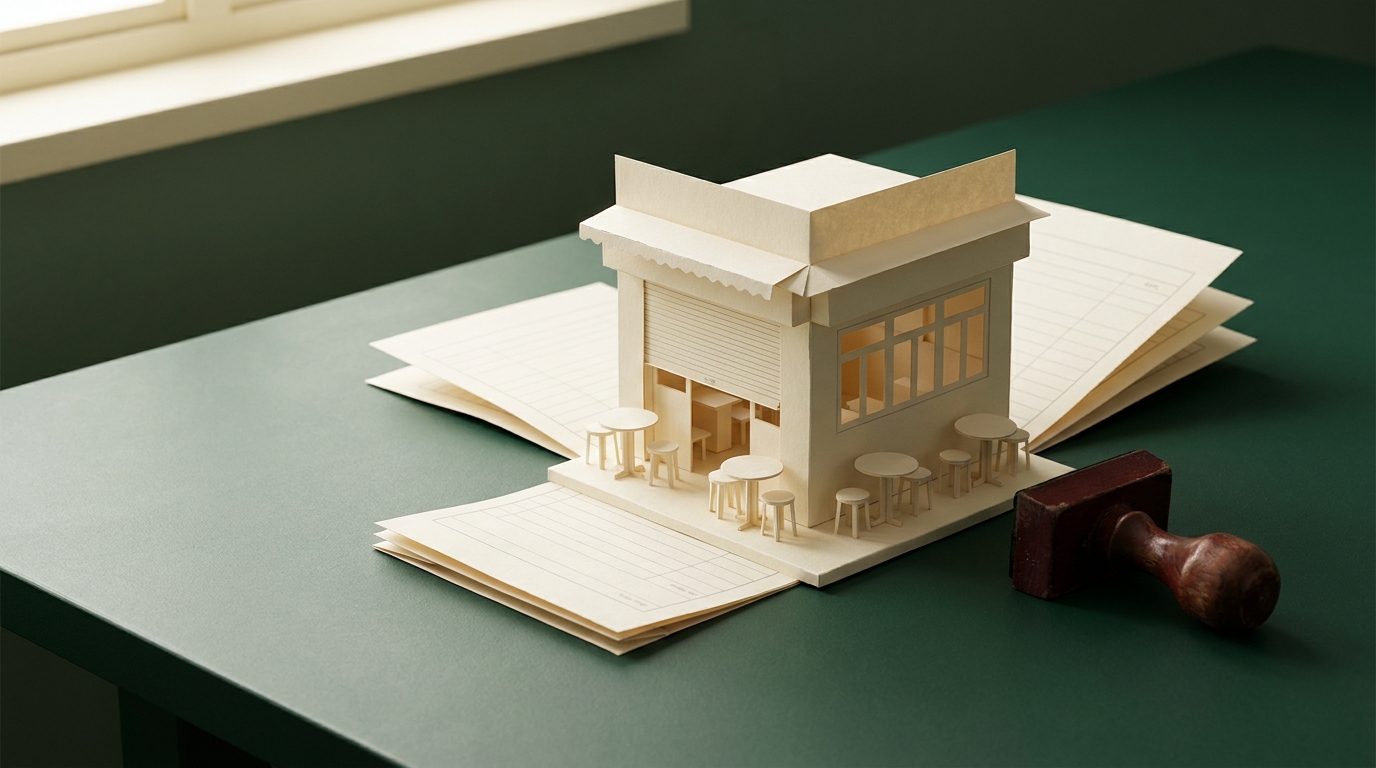
I keep noticing how much routine administration in Hong Kong still revolves around forms, signatures and company chops. The useful AI opportunity is in helping the next person understand what those documents establish, and what has changed since they were checked.
Restaurant licensing makes that concrete. A business needs to assemble evidence about a physical place. Drawings get revised. Different people examine different parts. An earlier comment can refer to a version that has since changed.
I would start with one task: prepare a clear record of the latest documents, show where they disagree, and identify which earlier checks need another look. That is a specific AI system a business could test.
Independent design study based on public information. The example below is fictional and demonstrates a proposed workflow.
There is a documented coordination problem.
The Audit Commission’s October 2023 review examined 50 food-business licence applications received in 2021 and 2022, selected for long processing times. They included 30 restaurant applications and 20 other food-business applications. Across that sample, applicants revised layout plans 569 times: between 3 and 37 revisions per application. [1 · Audit, §2.9]
These were selected historical cases, rather than a representative measure of applications today. The audit also recorded referral delays, requests for clarification and disruption during COVID-19. It does not establish how many revisions were avoidable.
FEHD has since changed the process. Its 2024 response described online progress checks and automatic deadline alerts. In April 2026, it introduced joint vetting for outside seating applications, with more information collected upfront and local consultations run in parallel. [2 · 2024 response] [3 · 2026 reform]
For outside seating, the reported median from receipt to approval was 12 months in 2025. The new expectation for simple cases is about one month to approval in principle. Those measure different endpoints; formal approval still follows compliance and inspections. [4 · EEB(F)116] [3]
That direction matters: give the people involved a clearer case earlier. My proposal applies the same idea to the applicant’s preparation work.
applications selected for
long processing times
layout-plan revisions
across that sample
2021–2022 applications, examined in the 2023 audit. Includes restaurant and other food-business licences. These figures describe the sample; they are not a current average or an estimate of avoidable work. Source: Audit Commission, §2.9.
A document can be genuine and out of date.
The company chop is the visible part. FEHD’s published instructions for provisional licence applicants still specify a company chop on the authorisation and compliance report for corporate applications. [5 · Licence Issuing Offices]
Digitising that document would make it easier to store and retrieve. Someone would still need to establish whether it relates to the current version of the premises.
Consider a fictional café. Its coordinator has a drawing marked V02 and a professional’s covering note referring to V02. A replacement drawing arrives marked V03. The covering note remains in the folder.
Every file is present. The unresolved question is whether the earlier review still covers the revised proposal. A system that counts uploaded documents could show a complete folder while leaving that question unanswered.
Each check would carry the document it relied on, the version reviewed and the person who recorded the outcome. When a later version arrives, the system would flag the linked check for review and preserve the earlier record.
The reviewer could then see why something needs attention without reconstructing the correspondence.
Separate receipt, consistency and acceptance.
I would give those three things their own status. It makes the handover clearer and prevents an upload from being mistaken for a completed check.
That distinction also gives the owner a useful explanation: what arrived, what needs checking and who can move it forward.
interactive specimen · fictional information
A new drawing arrives. Follow the earlier check.
Choose a condition to inspect the record. The demonstration uses prepared scenarios; it does not run an AI model or assess a licence application.
Example café / document review
Prepared specimen · no real applicant or address
What the documents say
What needs attention
The new drawing is V03. The covering note and earlier review refer to V02.
The flag requests a re-check. It does not declare a certificate invalid, certify safety or predict the licensing decision. The earlier review stays attached to V02.
Give AI the reading and comparison work.
In a working version, I would use AI to propose readings of document text, identify references to earlier correspondence and draft a short explanation of a mismatch. Each extracted detail would link to its location in the source. A poor scan would remain unresolved until someone checked it.
Once the version references were confirmed, ordinary software could compare them, maintain the record and reopen linked checks. The model would help interpret untidy material; the record would follow explicit rules.
I would begin with the coordinator preparing the submission. They could use documents they are authorised to handle and produce a review pack for the existing submission route. Access to government systems would be a separate project.
Drawing geometry, safety compliance and professional certification would stay with the people qualified to assess them. A change in a version label can trigger a question; it cannot establish the answer.
The communication work is part of the design.
A status page should tell the restaurant owner why the case is waiting and what happens next. The professional needs to see the changed document and the check linked to it. Those are different views of the same record.
An interactive page can make those relationships inspectable. A short film or presentation can explain the proposed process before a team adopts it. The workflow itself has a separate job: keeping that explanation accurate as the documents change.
Measure the work needed to reach a checked handover.
I would test this on permitted, redacted historical cases, replayed in the order the documents originally arrived. Include late revisions and unclear scans. Keep later outcomes hidden until the system has dealt with the earlier material.
- Can the reader verify every extracted detail?Check it against the cited page, including the mistakes a reviewer has to correct.
- Does a changed document reopen the right questions?Count missed conflicts and unnecessary flags. Both create work.
- Does the next person need less explanation?Measure preparation and checking time together, then count follow-up requests caused by an unclear handover.
There is no measured saving behind this study. A pilot would need to show that reduced searching outweighs correction and review effort. Licensing time would need separate measurement, because compliance work, inspections and external decisions also affect it.
The next useful conversation is with someone who assembles these cases regularly. I would ask them to walk through one revision that changed what happened next. That would establish whether this is the right task to build around, and which part of the handover deserves attention first.
Checked 9 September 2026
- Audit Commission: Licensing of food premises, 27 October 2023. §2.7–2.9; the selected sample and layout-plan revisions. Printed pages 26–27, PDF pages 42–43.
- Government response to Public Accounts Committee Report No. 81, 22 May 2024. Online progress checks, timestamps and deadline alerts.
- FEHD: new joint-vetting arrangements for outside seating, 1 April 2026. Revised procedure and the distinction between approval in principle and formal approval.
- 2026–27 expenditure replies, EEB(F)116. Printed pages 355–356, PDF pages 361–362; the 2025 outside-seating median and intended new milestone.
- FEHD: Restaurant Licensing Resource Centre and Licence Issuing Offices. Published instructions for provisional licence applicants, including the corporate signature and chop requirement.
The public sources establish the historical findings and published procedures. The interpretation, three-stage record and fictional demonstration are Enzwa’s design proposal. This study does not assess FEHD’s current internal systems or provide application advice. For an actual application, use FEHD’s current guidance and the relevant professional advice.
work with Enzwa
Explain a process. Improve a repeated task.
I create presentations, films and interactive pages that explain complex ideas. I also build practical AI systems for repeated tasks.
Make the process clear
A presentation, film or interactive page to help people understand how something works.
Explore communication workMake the task easier
A working system for a repeated task that takes too much time or checking.
Explore AI systems