the route 01cerebras systems · nasdaq, may 2026
Cerebras filed its S-1 twice. The first sat in public for 368 days; the second priced in 26.
Cerebras took its registration statement public on 30 September 2024 with one customer at 85% of revenue and a national-security review unresolved. It withdrew the filing 368 days later. It refiled on 17 April 2026 with an OpenAI contract signed, and priced 26 days after that at $185, above two raised ranges. The document did not improve. The facts it was required to disclose did.
What it had to sell
Cerebras Systems, Sunnyvale, founded 2016. It builds a processor the size of a dinner plate: the Wafer-Scale Engine, one chip cut from an entire silicon wafer at 46,225 mm², where the rest of the industry cuts a wafer into hundreds of separate chips and then spends its engineering budget making them talk to each other. The company had 708 employees at the end of 2025 and was selling into a market defined by one competitor with roughly nine tenths of it.
Revenue was real and growing fast: $290.3m in 2024, $510.0m in 2025, up 76%. The problem was never the growth. It was who the growth came from.
The route
Drawn on a time axis, so the waiting is the right length. Every mark is a filing on EDGAR; the shaded stretch is the period the company’s registration statement was public and going nowhere.
Every figure on this page is read off the filings themselves and the arithmetic re-run. Sources at the foot.
public, and stalled
Scroll the rail sideways →
Three things it did well
A filing that cannot price is a standing liability, and they stopped paying it
On 3 October 2025 counsel wrote to four named staff at the Division of Corporation Finance and asked, under Rule 477, that the registration statement be withdrawn: “the Company does not intend to conduct the proposed offering that is described therein at this time.” Fees paid were credited forward under Rule 457(p); supplemental materials were requested back or destroyed.
The alternative was to keep amending and keep waiting, which is what most companies do, because withdrawal reads as defeat. It is the cheaper move. A live registration statement fixes your disclosed numbers in public while your business moves on, and every month it sits there the gap between the document and the company widens. They took the visible loss and closed the file.
The second draft went in the same week the OpenAI contract was signed
In December 2025 Cerebras signed a multi-year agreement with OpenAI: 750 megawatts of compute, a stated value of more than $20bn, a $1.0bn working capital loan and a warrant over 33,445,026 shares. The second confidential draft registration statement was filed on 22 December 2025. In March 2026 they added AWS.
The 2024 problem could not be drafted around. A risk factor explaining why one customer at 85% of revenue is acceptable is still a document saying one customer is 85% of revenue. What changed between the two filings was the customer list, and only then the filing.
Everything contestable was settled in confidence first
Second time through: confidential draft on 22 December 2025, amended in confidence on 31 March 2026, public S-1 on 17 April, two amendments, priced on 13 May. The registration statement existed in public view for under a month, and every question the staff had was already answered when it got there.
That is what the confidential process is for, and it is worth naming because the same company had already demonstrated the other way round.
Three things that would have gone better
$4.35bn between the number they set and the number the market paid, on the day
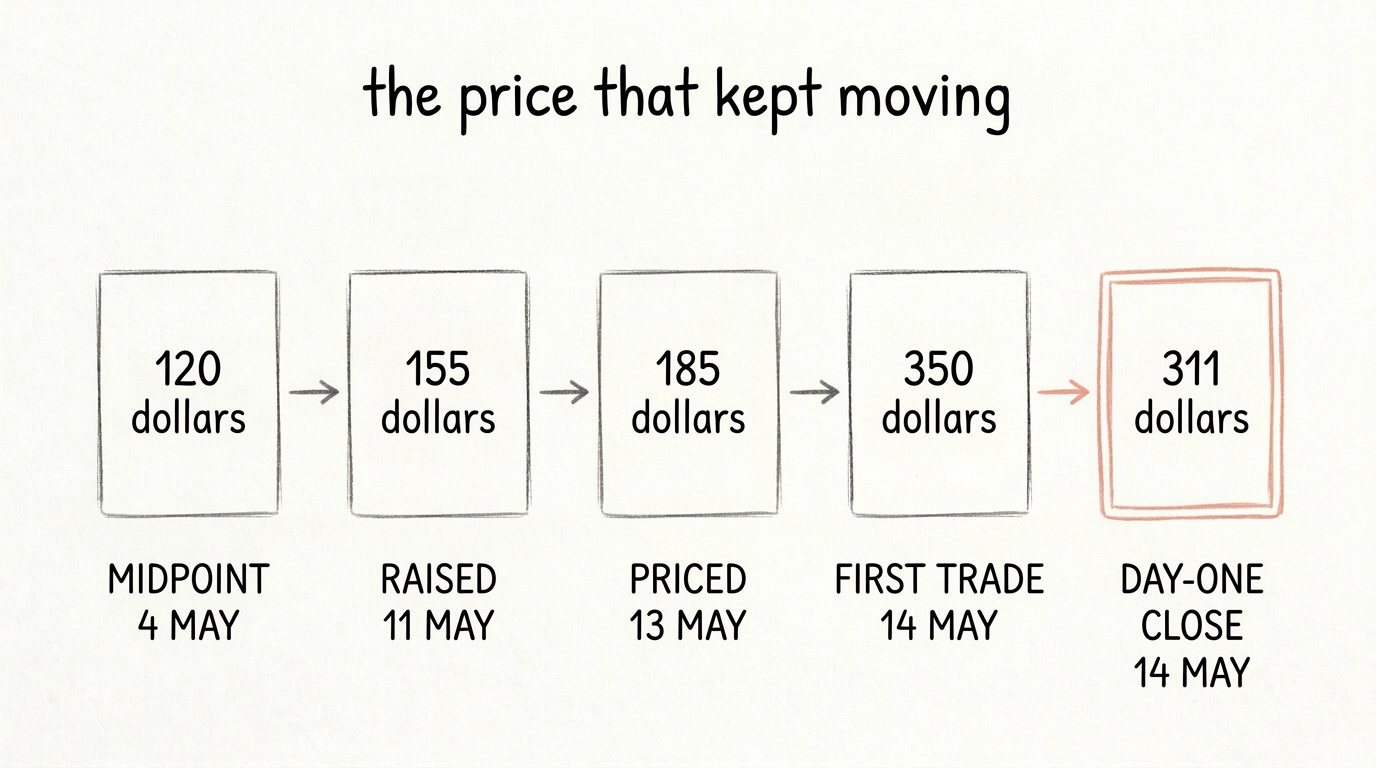
The book moved twice in nine days. The 4 May amendment assumed $120.00, the midpoint of its range. The 11 May amendment assumed $155.00. They priced at $185.00, above both. Then the stock opened at $350.00 and closed its first day at $311.07.
Take the standard measure: first-day close less offer price, times shares sold. $126.07 × 34,500,000 = $4.35bn. The underwriting discount on the same deal was $4.3475 a share, or $150.0m. The fee for setting the price was one twenty-ninth of what setting it cost. It is also more than the $2.85bn of equity the company had raised privately in the nine years to that point.
There is a real counter-argument and the page should carry it: a first-day close is not a valuation, it is the clearing price for a very small float against a queue, and this one gave back roughly a tenth the following day. Two raised ranges in nine days is still a book telling you something, and they stopped $126 short of where it settled.
85% of revenue from one customer became 86% from two, both in the same country
The 2024 filing disclosed G42, an Abu Dhabi AI group, at 85% of 2024 revenue. The 2026 prospectus discloses G42 at 24% of 2025 revenue and MBZUAI, an Abu Dhabi university, at 62%. Together that is 86%, and the accounts receivable line tells the same story: one customer was 91.0% of the balance at the end of 2024 and 77.9% at the end of 2025.
The new anchor does not remove the shape either. The prospectus describes the OpenAI agreement as “a substantial portion of our projected revenues over the next several years”, and the same customer holds a billion-dollar loan whose funds it can direct on a trigger event. The risk was restructured into a form the market would buy. The filing says so plainly, which is to its credit; the headline the listing was sold on does not.
The confidential process was running, and they left it too early
The first draft went in on 17 June 2024 and was amended twice in confidence. On 30 September 2024 the company flipped it to public, with the CFIUS review of G42’s stake unresolved. Everything after that was a matter of public record: the delay, the year of silence, and eventually the withdrawal letter itself, which is on EDGAR permanently and was read for this piece.
The clearance came in 2025. Nothing about the review required the document to be public while it ran. The second attempt shows the company knew that, because it did the opposite and it worked.
Three views, drawn
No filing artwork is reproduced. The left panel is the record as the documents state it; the right is how we would put it in front of a board. Toggle between them.
01 · What the price did in nine days
Swipe the panel sideways →
One row, five stops, and the gap named underneath it. A board can see the decision and its cost without being walked through either.
02 · The risk that was restructured
Swipe the panel sideways →
Two panels, one comparison, and the reader reaches the conclusion before the sentence explaining it.
03 · Where every number on this page came from
Swipe the panel sideways →
The slide almost nobody builds, and the one that survives a hostile read: it answers the question before it is asked.
The law it proves
A document cannot argue past a fact it is required to disclose. Change the fact, or file later.enzwa · craft law 02
Nineteen months of drafting would not have made the 2024 filing work, and no drafting was what fixed it. A customer contract signed in December 2025 fixed it, and the document that followed took four weeks in public. This is the limit of what writing does, and it is worth knowing where that limit sits before commissioning any of it: the work of a disclosure document is to state a position clearly enough to be checked. It cannot hold a position the facts will not support.
Which is also the useful half. Once the facts are right, the document is the whole of what the reader gets, and the difference between a clear one and an unclear one is measured in weeks of review and, on the evidence above, in the price. The companion finding is the Airbnb deconstruction, where the numbers chain closes and one footnote does not.
Sources
The route is a series: one company’s path to a listing, read through the documents that carried it. Public filings only, no artwork reproduced.