the route 02space exploration technologies · nasdaq, june 2026
The largest IPO in history took 74 days from first draft to priced. Cerebras took 695.
SpaceX filed its first confidential draft on 30 March 2026 and priced on 11 June: 74 days, and the registration statement was public for 23 of them. It named a single price where a range would sit, never moved it, and paid $500m of underwriting on $86.25bn raised: a flat fee that stayed the same when the deal grew by 83 million shares.
What it had to sell
Space Exploration Technologies, Starbase, Texas, founded 2002, with over 22,000 full-time employees at 31 March 2026. The prospectus reports three segments: Space, Connectivity and AI. Starlink sits in the second of them, and it is the largest of the three and the only one that made money.
In 2025 the Space segment produced $4,086m of revenue, 21.9% of the total, and lost $657m at the operating line while funding $3,004m of Starship development. Starlink carried the business: $11,387m, 61.0% of revenue, and $4,423m of operating income. The AI segment, acquired 56 days before the first draft went in, produced $3,201m, lost $6,355m, and took 61.4% of the year’s capital expenditure.
The route
Drawn on a time axis, so the waiting is the right length. Every mark is a filing on EDGAR. The first shaded stretch is the period the registration statement existed only in confidence; the second is every day it spent in public view.
Every figure on this page is read off the filings themselves and the arithmetic re-run. Sources at the foot.
in confidence
in public
Scroll the rail sideways →
Three things it did well
Two drafts in confidence, then a public filing that was never materially amended
The first draft registration statement went in on 30 March 2026 and was amended once, in confidence, on 7 May. The public S-1 followed on 20 May and the offering priced on 11 June. Between those two dates the company filed two amendments and answered nothing contentious in public.
This is what the confidential review process is for, and most companies use only half of it. Everything a reader could have argued with had already been argued, so the public document had 23 days of work to do and did it.
$500m flat, and nothing at all on the over-allotment
The cover states $0.90 a share against an offering price of $135.00, and then states that the underwriters take “no discount or commission” on over-allotment shares. The option was exercised in full: 83,333,333 extra shares, $11.25bn of extra gross proceeds, and the fee did not move.
On $86.25bn of gross proceeds that is 0.58%. Cerebras paid 2.35% on a $6.38bn deal, and a conventional US listing pays several times that again. Twenty-two banks took the terms, ten of them as book-runners.
The document says on page four that the rockets are 21.9% of it
Revenue, operating result and capital expenditure for all three segments appear in the prospectus summary, before the risk factors. A reader reaches the Starlink number, the Starship research line and the AI capital expenditure without turning to the financial statements.
The three segment revenues sum to the consolidated figure with nothing left over, which is the first thing worth checking in any summary that splits a business up. It is a document that lets itself be checked early, and that is a choice.
Three things that would have gone better
One figure, published once, and the market moved it 19% in a morning
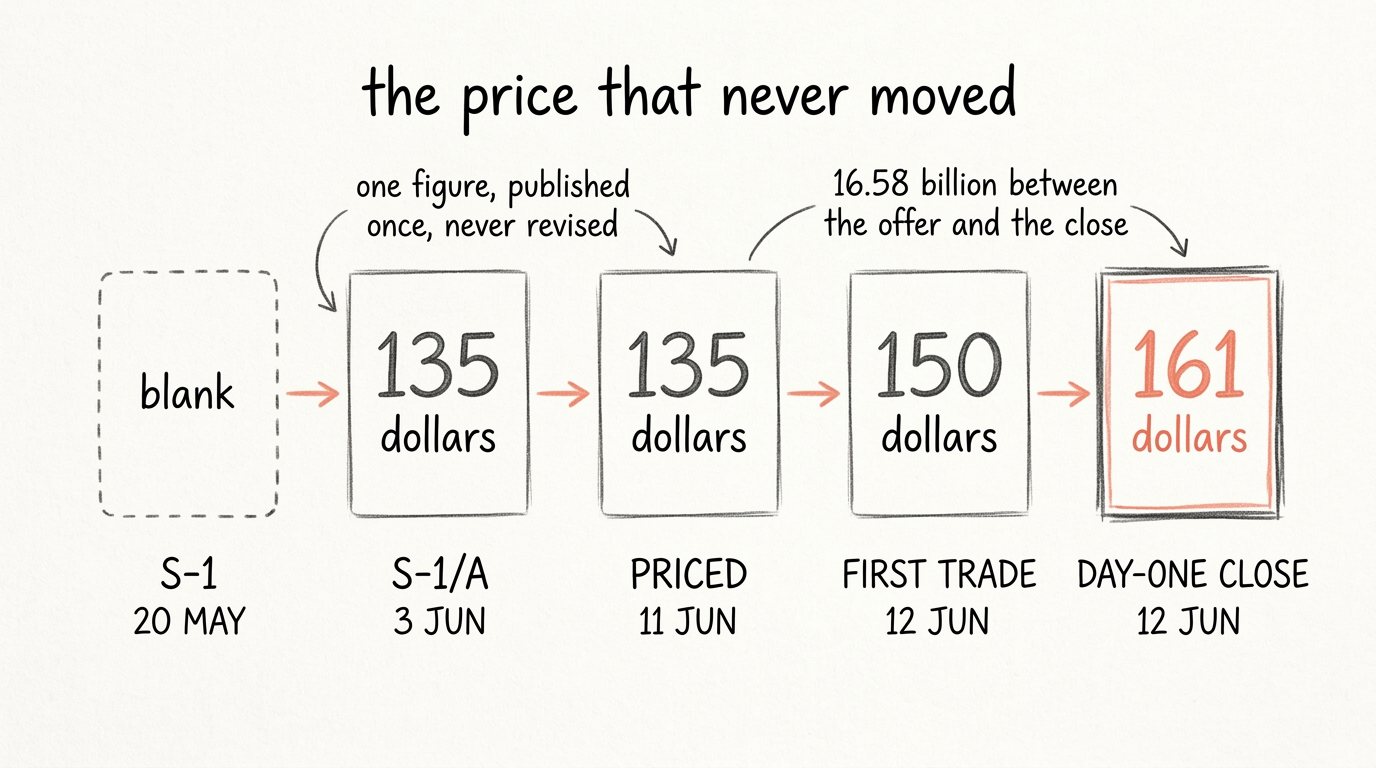
The cover of the 3 June amendment reads “We expect the initial public offering price to be $135.00 per share”. A range is the convention, and the reason is that a range is how a book gets read. This one published a single figure, priced there eight days later, opened at $150.00 and closed its first day at $160.95.
Take the standard measure: first-day close less offer price, times shares sold. $25.95 × 638,888,888 = $16.58bn. The underwriting fee on the same deal was $500m. The gap is 33 times what the pricing cost, and the same shape turned up on Cerebras at 29 times.
The counter-argument belongs on the page. The float was 4.9% of the company, and a first-day close on a float that thin is a clearing price against a queue rather than a valuation. Worth noting alongside it: a flat fee pays the same whatever the price does, so the usual argument that the banks were protecting their own percentage does not apply here.
The comparatives describe a company that did not exist in 2025
xAI was acquired effective 2 February 2026, and X Holdings by xAI effective 28 March 2025. Because both were transactions between entities under common control, the financial statements are prepared, in the prospectus’s own words, to reflect the “retrospective combination of the companies for all periods presented”.
So the $18,674m of 2025 revenue includes $3,201m earned by a business SpaceX bought eight weeks before it filed, and the $(2,589)m operating loss includes that business losing $6,355m. The treatment is correct and the basis is stated plainly, which is why the disclosure is not the failure. The exposure is that a headline built on the consolidated line describes an entity that was assembled after the year it reports.
A billion restricted shares vest on a permanent human colony on Mars
The CEO holds 1,302,072,285 restricted Class B shares. 1,000,000,000 of them vest on market-capitalisation milestones across fifteen tranches and on “a permanent human colony on Mars with at least one million inhabitants”. The remaining 302,072,285 vest across twelve tranches and on non-Earth data centres delivering 100 terawatts of compute a year.
Alongside that, Class B carries ten votes a share, the founder holds 82.4% of the voting power after the offering, and the company is a controlled company under Nasdaq’s rules and intends to use the exemptions. Each of these is disclosed and each is legitimate. Together they describe a security whose dilution schedule turns on events no financial model reaches, and the document offers the reader no way to hold them.
Three views, drawn
No filing artwork is reproduced. The left panel is the record as the documents state it; the right is how we would put it in front of a board. Toggle between them.
01 · A price that appears once and does not move
Swipe the panel sideways →
One row, five stops, and the gap named underneath it. The decision and its cost are legible without a walkthrough.
02 · What the company is, by revenue and by capital
Swipe the panel sideways →
Two columns, three rows, and the reader arrives at the finding before the sentence that explains it.
03 · Where every number on this page came from
Swipe the panel sideways →
The slide almost nobody builds, and the one that survives a hostile read: it answers the question before it is asked.
The law it proves
A document clears fast when there is nothing left in it to argue about. That work happens before the drafting.enzwa · craft law 03
Seventy-four days is not a writing achievement, and reading it as one is the mistake worth avoiding. Two confidential drafts settled whatever the staff would have raised. The public filing that followed went in with no share count and no price on its cover, which is a document with nothing left to contest, and it was contested for 23 days and then priced. The prose was never the variable.
Which is the useful half for anyone commissioning one. The time a document spends in review mostly measures how much argument it still carries when it arrives. The companion finding is the Cerebras deconstruction, where the same route took 695 days: a registration statement sat in public for 368 of them and was withdrawn, and what eventually fixed it was a customer contract rather than a rewrite.
Sources
The route is a series: one company’s path to a listing, read through the documents that carried it. Public filings only, no artwork reproduced.